
Preserving History
70-years ago, America experienced a wave of censorship due to a fear of communism and the spread of anti-capitalist and anti-American literature. Today, we are facing similar threats on history deemed "anti-American".
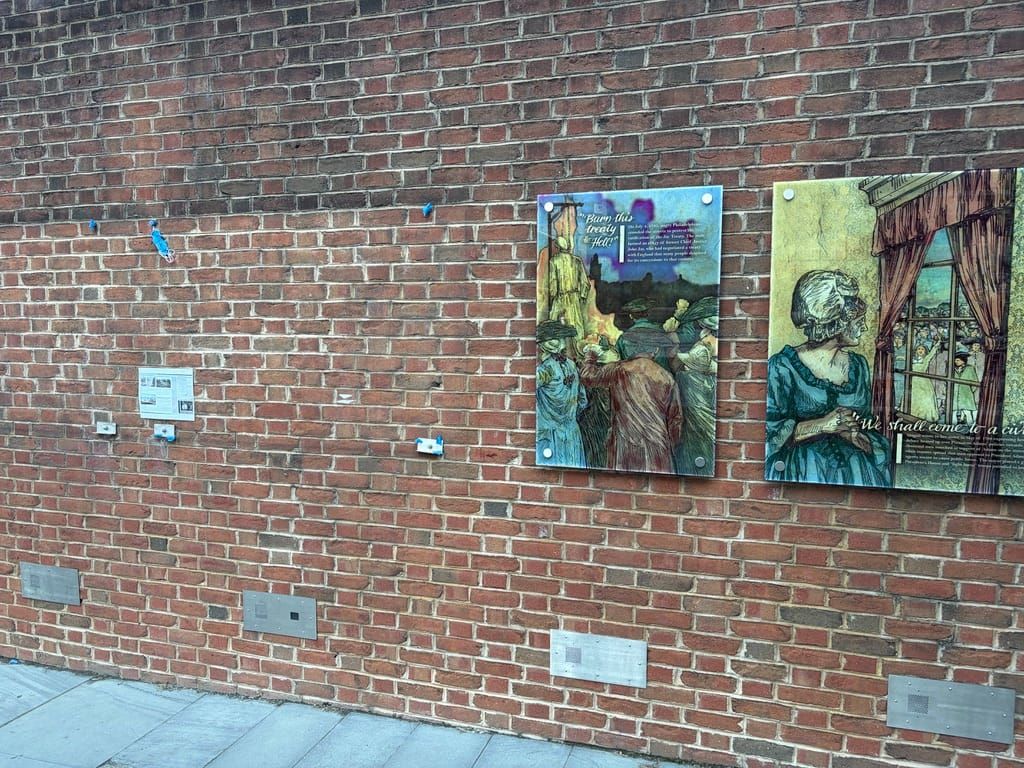
73-years ago, during the 1950s, America experienced a wave of censorship due to Senator Joseph McCarthy’s fear of communism and the spread of anti-capitalist and anti-American literature. The government even went so far as to ban and destroy books, influence college textbooks, and oust school leaders. Today, we are facing similar threats. Those in power today are fearful of what they deem “anti-American” and are taking part in tactics to censor it. Although modern technology and new progressive freedoms, such as instant access to all of recorded history on our cellphone. Could convince us that our history is permanently preserved unlike the 1950s, that, as we have seen here in Philadelphia, is simply not true.
On January 22nd, 2026, The Department of the Interior, on order from Trump and The White House, removed 34 panels from Independence Hall that contained details about slavery, President George Washington’s enslaved people, and the Trans-Atlantic Slave Trade as it pertained to Philadelphia. These panels have been at Independence Hall since 2010. This all comes a few months before the expected surge of tourists ahead of the 250th year anniversary of the United States on July 4th, 2026. Depriving visitors and residents alike, the opportunity to learn about the reality of America’s founding, its founders, and the horrors of slavery.
Trump and The White House’s overreach will not stop at Philadelphia. College campuses across the nation are currently being targeted by Trump’s “Restoring Truth and Sanity To American History” executive order, potentially dooming us to repeat the same anti-truth hysteria of the 1950s and exacerbating our need for transparent history, unless we wish to repeat it. How far will Trump and the White House go to hide and white-wash our history? And who, right now, is standing up for Philly and the preservation of its history?
Trump’s executive order hopes to give the federal government a pathway to rewriting history and hopes their revisions will “ignite the imagination of young minds, honor the richness of American history and innovation, and instill pride in the hearts of all Americans”. To achieve this, the Department of the Interior has been ordered to remove exhibits that demonstrate “partisan ideology” and "disparage Americans living or past, including colonial times” from not just the Smithsonian, but lots of Federal museums and significant sites.
This effort to preserve the “good name” of White Americans and their forefathers, comes ahead of the 250th anniversary of the signing of the Declaration of Independence, which The White House hopes instills all 350 million Americans with a sense of unbridled patriotism.
The removal of the slavery placards at Independence hall is one of the first attacks from the government against our history and Philadelphia’s history of slavery. Something the City of Philadelphia and its Mayor, Cherelle Parker, have adamantly claimed the Federal Government had no authority to do. Where there used to be a series of placards and televisions telling the stories of the enslaved people owned by George Washington and stats pertaining to people enslaved in the United States in the 18th century, now only empty brick walls remain. Spectators and tourists used to be able to receive a history lesson on their walk through Independence Hall. Now, on the way to the Liberty Bell, the history lesson that once awaited you is gone.
After many weeks and lawsuits later, the slavery placards in part, were redistributed to Independence Hall. However, the watching of our history attempting to be erased left a bad taste in many Philadelphians' mouths.
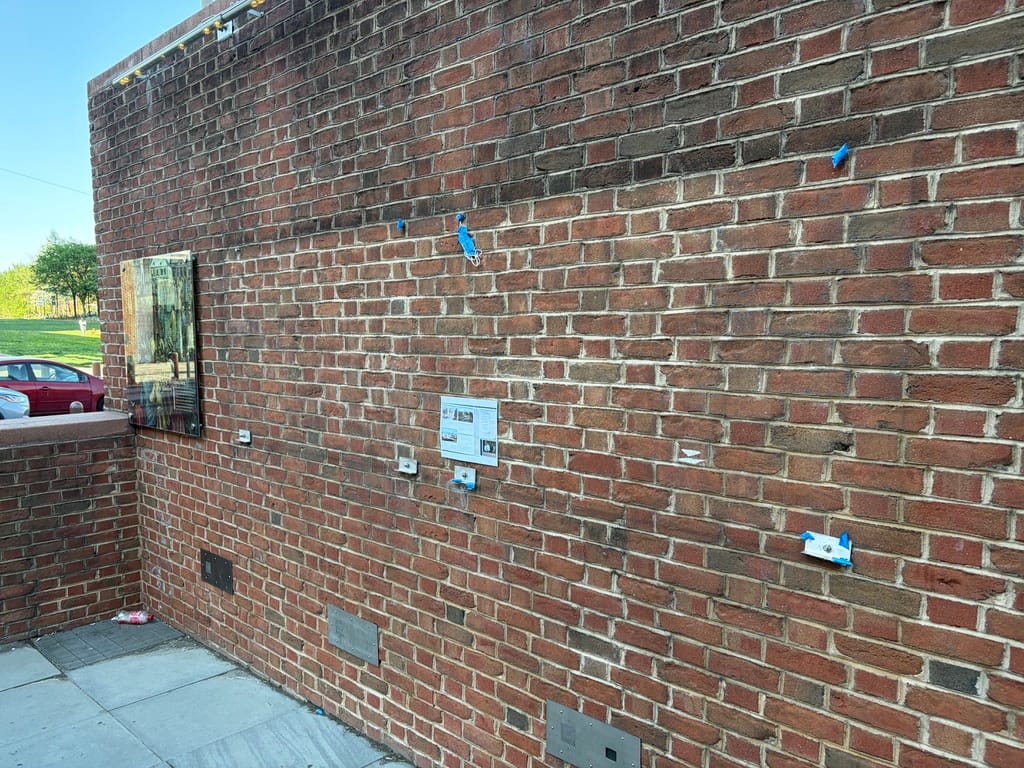
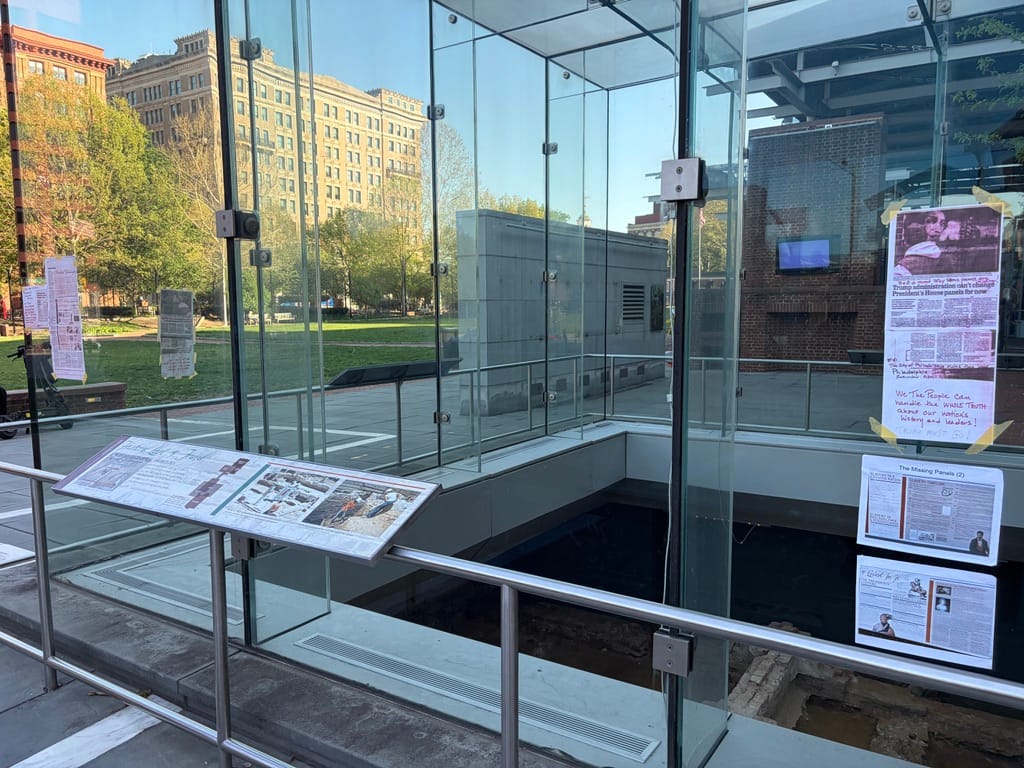
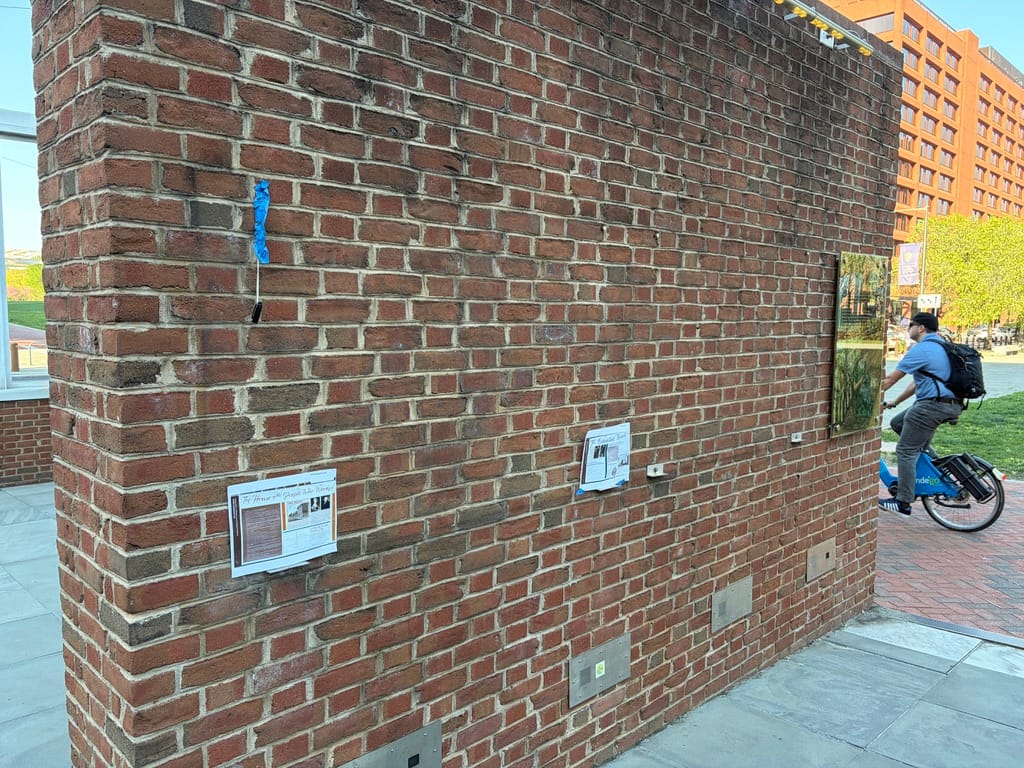
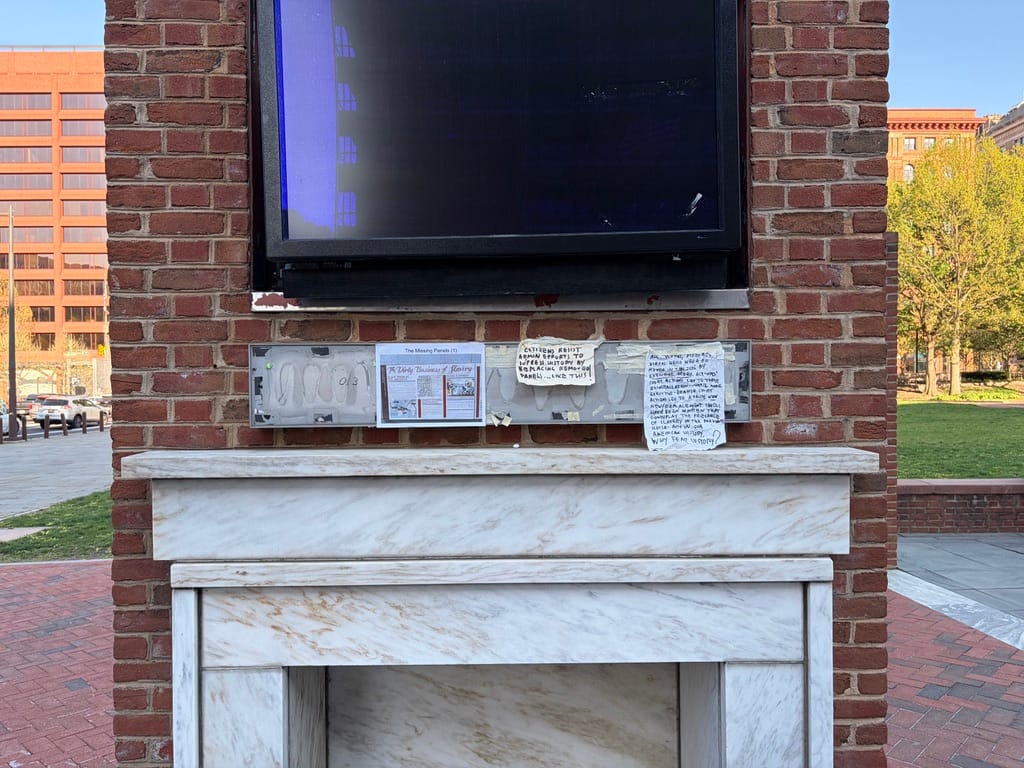
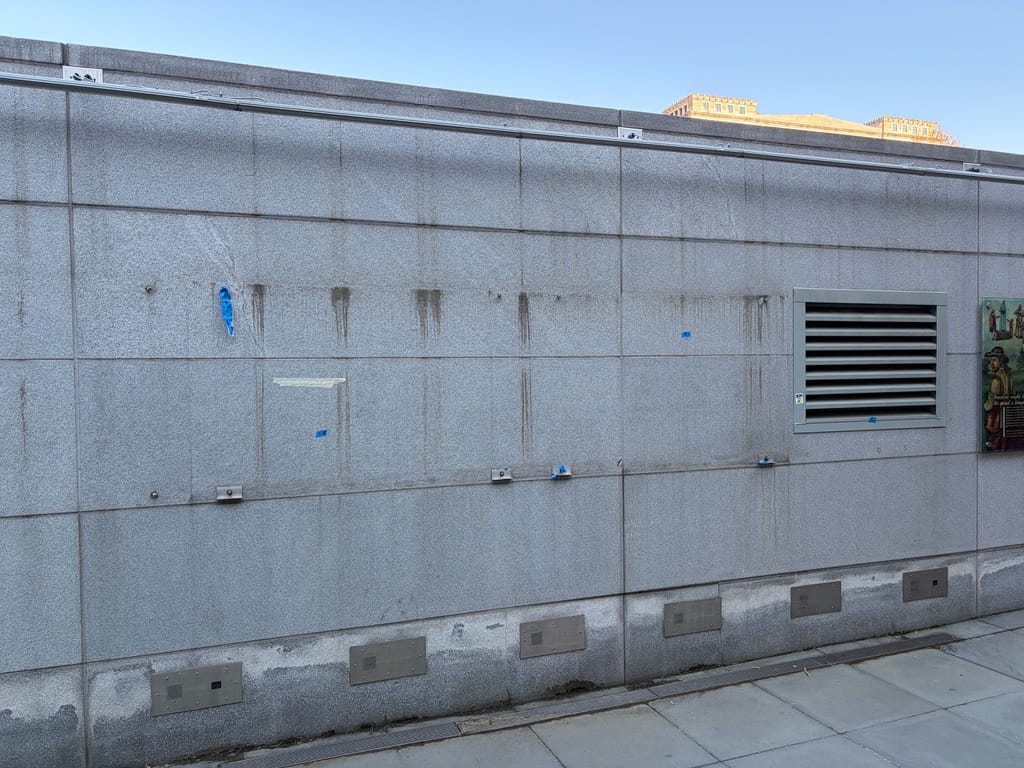
Placards after having been "returned"
The lengths of abuse and mistreatment of enslaved Africans by early Americans is widely documented and important to our history, not just as Americans, but as humans. It’s important to those whose families lived through it and to those who fought against it, not to mention those who are not interested in repeating such history, should be fearful of forgetting it. Taking away these placards, although not directly erasing the history, removes it from the public’s view at a divisive time in the United States ahead of its 250th anniversary. An event where we could be simultaneously celebrating the founding of our nation and its progress, while being critical of our nation for its current and previous shortcomings. The founding principles of this nation were written and conceived by slave owners. A fundamental contradiction to itself that deserves to be scrutinized, not hidden.
The removal of these placards is indicative of a larger approach by the White House to “revise” American history through a sanitized, non-critical lens, in hopes to make the White people that founded this country appear less of who they really were, as well as hide things that the Trump’s administration thinks of as “harmful”. This manifests itself as book banning, curriculum or syllabus censorship, and historical text’s revisions or removals, especially those that contradict an ethnocentric viewpoint of American History.
Although everyone is affected, African Americans who stand to have their history publicly erased are most affected. Personal histories are able to survive generations, but the blend of personal history and public history is what keeps us motivated to stay empathetic and understand the failings of the United States to African Americans. Lacking that basic understanding of our country's history prevents us from making connections about systemic failures back then, to similar problems now.
Philly is expected to see 1.5 million visitors this year due to the 250th anniversary of the U.S. and the World Cup. These visitors will come to Independence Hall, one of Philly’s most popular attractions, and not be able to learn the true history of the “President’s House” or Philly’s role in the Slave trade. Having these placards displayed in a half-assed state shows an America divided on facts and their role in history.
U.S. District Judge Cynthia Rufe compared the removal of the placards from the President’s House Memorial to George Orwell’s 1984, a dystopian novel about government power. Saying, “As if the Ministry of Truth in George Orwell’s ‘1984’ now existed, with its motto ‘Ignorance is Strength,’ this Court is now asked to determine whether the federal government has the power it claims — to dissemble and disassemble historical truths when it has some domain over historical facts,” Rufe wrote in her decision. “It does not.”
Philadelphia’s Independence Hall is not an isolated incident of factual history perceived by the White House as anti-American, being taken down around the country. According to internally obtained documents from the Washington Post, The Trump Administration has ordered the removal of signage referencing climate change and Native American history at national parks, including Glacier National Park and Grand Canyon National Park. National Parks Conservation Association Senior Vice President for Government Affairs Kristen Brengel issued the following statement:
“The administration is suppressing truth, facts, and science at our national parks and that should alarm every single American. This dangerous campaign to erase history and science is a tremendous insult to the national parks we know and love. The administration is forcing National Park Service staff to censor science and history. This is a violation of the core tenets of the National Park Service’s mission.”
The approach of Trump and the White House to remove history they deem harmful, and in return, harming those like the Avenging the Ancestors Coalition and its founder Michael Coard, along with advocacy organizations like 1838 Black Metropolis Collective, who worked so hard to get this history into the public’s view, shows a one-sided approach to “repairing truth and sanity”. They want “truth and sanity” so long as it’s not overly critical of White people or our founders. Removing historical sites, censoring history and education’s curriculums, is a textbook play for a budding authoritarian. Hitler’s Nazis in occupied France and Belgium would destroy World War One memorials and pieces of cultural history in an attempt to alter the cultural memories of occupied peoples. These parallels paint a bleak picture for America unless we can organize and fight for our memorials and institution’s right to express the freedom of speech, regardless of who it incriminates.
Censorship and removal of historical artifacts undoubtedly put our nation’s history at risk. But a growing trend of “reimagined” history lessons that paint America’s leaders and historical figures in a false light, dooms the next generation that will be reliant on this alternate history.
An example is PragerU, which bills itself as an “influential media organization” that “promote[s] American values through the creative use of digital media, technology and edu-tainment… with free content that helps people of all ages think and live better while upholding Judeo-Christian values”. Amongst many of their edu-tainment videos there are careful omissions and deflections of truth and contextual elements in each historical lesson. In specific is a video, targeted towards children, about Christopher Columbus. Around the 8-minute mark this version of Christopher Columbus snakes his way around accusations about his supposed enslaving and murdering. He proceeds to justify slavery and asks not to be judged by today’s standards. This is a chilling look into what the White House, a partner of PragerU, envisions for its replacement for all the history they plan to censor and take away.
We got to speak with Matthew Palmer, the spokesperson for the 1838 Black Metropolis Collective, a non-profit that specializes in preserving Black history in Philadelphia, and was a key voice in the conception of the President’s House Memorial as well as subsequent fight for its return.
What does it mean to preserve Black history? What active steps need to be taken?
That's a great first question. So moments like this, right where you are open to dialogue about what black history is, the truth about black history, the complexity of said history and the sharing of that history. Um, second active listening, you can't preserve something if you don't know it's under attack, right?
Slight tangent, ATAC [Avenging the Ancestors Coalition], the organization that created that amazing monument, including Hercules, Giles, Richmond, and all of the individuals that were enslaved at the president's mansion, only happens because Philadelphia takes a moment. And realizes that there's history being untold. It took ATAC $8 million and 10 years to put up that exhibit.
That is not a city funded or state funded exhibit. That is a private funded exhibit, right? So in the preservation conversation, we're talking about an encroachment upon the city's right to tell its own story, right? Um, and because of that preservation looks a little different than it would for regular artifacts, right?
Like it's not a museum, it's outside. It is imperative that it is protected from weather and all those things, right? That's not done by the National Park Services. That's done by ATAC. So because it was deemed to not paint the United States in a positive light, which is accurate, right? We're not fighting against somebody saying fully that this history didn't happen.
That's not the conversation. The conversation is that we dislike how history is being told. So from a preservation standpoint, that was nice. We're fighting, not inaccuracy, but our freedom to tell a story based on historical research. Um, so the legal battle is about whether or not as citizens of the city, we have the right to put up exhibits based on historical research.
Um, so yes, the case was won. Currently it's still being won. It's also being appealed. Currently, the way the law works, it will be in this process for a while. It's kind of in like a weird limbo.
Yes. Some of the panels are up.
Yes. Most of them were not stored properly.
Yes. The ones that aren't stored properly have to be redone.
Right. So in an attempt to silence the story. There is a part of a successful thing that's happening on the opposition side in that if the whole story's not up, you're still losing a part of the history. Right. Um, so that second thing I would say is taking active steps to know your own history. A lot of times when we talk about preserving black history, we want to immediately go to the Harriet Tubmans, to the William Stills, to the James Fords.
Um, and a lot of times we forget that we have history ourselves. Um, like I'm first generation Philadelphia, my parents are from the South, so my Philadelphia history starts with my mother and father's interactions in high school. A lot of families in the city of Philadelphia have been here since the 1600s.
That family history is probably a lot more contextually important than the major stories. And the more we find those out, the more we can paint a broader picture. Um, and so that's why. We do our work based on the census. 'cause it's not just the amazing stories of people like James Horton, but it's also stories of like regular people, right?
Like a guy named Peter Johnson who you don't know but who purchased his own freedom, moved to Philadelphia, bought a house and got married. Super important story because it shows that that was possible, but it's just not popular. Um, so not making it all about the big guys. So communication, knowing your own personal history and being willing to be wrong.
Because history is so contextually complex. A lot of times people are a little finicky about going, I thought I knew that, but I don't know it entirely. Right. It is okay to have a misconception about history. Mm-hmm. Because you were not there. Right? So getting past that I think gives people a little bit less angst about what they consider historical and how to.
One of the things also listed on y'all's website was a list of accomplishments for each year. And in the second year there's one that says, “digitized one major Black History archive” Is digitizing history the final step or final boss in preserving history?
That's one I like “Final Boss”, so you probably play video games? I also do, I think they're important for the brain.
Um, is it the final boss? No.
Is it a final boss on a level? Yes.
Okay. Keep in with the game metaphor and let me know if y'all don't game. So I can like, real-world it. The game never ends. It is an infinite two level game. It's only two levels.
First level is uncovering, second level is reclaiming.
That's it. That happens in different spaces. In different ways, right? Physically, with books, people don't really read books no more, right? So then you get to digitally, you could shut down the website with a button. If they didn't want that website up, it wouldn't be up, down. And then all of that digital information is kept on the laptop it was originally put on and in the memory of people who see it.
And so that gets me to the third one, which is oral history. Oral history is the most powerful piece of social preservation that we have as a community of people of color, oral history is the most important, mainly because it doesn't get destroyed with a click of a button or a burning of pages. And so in order for us to get to a final boss, I would say oral history is the final boss.
And making it so that these stories aren't as complicated as a 10 page novel. Right? Like I could tell you the story of Hercules in like 50 seconds in a way that maybe it doesn't give you context, but you're aware.
I don't know. I'm a nerd. I don't know if y'all into quantum physics, but when you're aware of something, it operates differently. That's how all atoms work. Everything in existence is just light particles slowed down to a specific speed of operation. If you don't believe me, we can talk about that later.
All right. So the more aware of something you are, the more it grows. Right? You have an idea. You tell somebody that idea, they talk about that idea. That idea has legs. That's what we say, right? Works the same way for stories. It works the same way for history. It works the same way for fear. It works the same way for your aspirations and manifestations.
Like these things are very important to be cognizant of if you're doing the work. Um, and if you're like, nah, that's too sciency. You ever tell somebody something and tell 'em not to tell somebody, and then you hear it from somebody else? That's because once they're aware of it, it will operate differently In the shared social space, sometimes that means it will be shared in the social space, right?
And so the goal with this stuff we're talking about is to share it in social spaces.
In dealing with the slavery placards removed from Independence Hall, how can we ensure that those restorations are going to be accurate and not continue to further erase history in the way that our [administration] is trying to?
How can we ensure accuracy? I wanna be optimistic. So I'll answer the question with an affirmative and then I will give my pessimistic personal opinion. Um, the way we can affirm it is by sharing it. The way we can affirm it is by visiting the site. Double checking it is by, I know it sounds real corny, but civic engagement.
Right. Write your council members, write the mayor, write the governor, write the president. He not doing nothing. You know what I'm saying? Like he on Twitter, shoot him a tweet. Like, unfortunately, engaging in that way is one of the most effective. Even if the person you're intending it for doesn't see it, that awareness thing comes back.
Right. The more people that are aware, the more legs it has, the more likely something happens.
Um, my personal pessimistic opinion, the expectation that people who don't want you to know something will keep accuracy and the things they don't want you to know is a large part of the reason why we have to reclaim this history in the first reason, right?
If I like Nike's and I want to buy some Air Maxes, I'm not going to go to the Adidas store 'cause they don't want me to have Air Maxes. They would much rather me wear some shell toes. I don't want shell toes. So if you want history. I personally don't like it, but you, you should, right? If you want history of a people, you might have to go to people who are of that community who are doing work to preserve it, right?
I know you said that we are not fighting inaccuracy, but our freedom to tell our stories. I want to know, do you think that telling the full truth about the history of our country would make us stronger or weaker?
Um, so telling the full story from my perspective, I think makes us stronger. But if I'm gonna take my personal beliefs out of it, because we are at a very sensitive time globally, I think telling the full story gives an opportunity for you to find out who's strong and who's weak. I don't think it blatantly makes us one or the other, but I do think it shines a light on who's a little sensitive about things that may be.
Um, I think I'm nosy, so I wanna know everything about everything. I don't like that the conversation about Harriet Tubman is what we know about the Underground Railroad and she didn't start it. You know what I'm saying?
Like, great story, amazing woman. Probably one of the most important figures in American history, but that's probably because we don't know the 200 to 300 people who came before her, who showed her that work was possible, right? Yeah. If we know those people, that doesn't diminish from her story, but it does contextualize it a little bit.
And so that's how I feel about it. Um, and I also like, because I do tours when people feel the opposite, right? When they're like, I don't know, this history makes me feel like you think these people are bad. And I'm like, your projections aren't necessarily my responsibility. But if we are having a conversation, I do need to hold space for them.
Right? 'cause I can't tell you something and have you factor it into your psyche if the wall is solid. Know what I'm saying? So yes, I think it makes it stronger, but it'll show you who's weak and be nice to those people. Something else.
Matthew Palmer raised some interesting points and questions about history preservation and the pursuit of truth. People like Palmer and organizations like Avenging the Ancestors Coalition and 1838 Black Metropolis Collective are actively working to defend Philadelphia’s history and fight the current administration’s obsession with the “good name” of our forefathers. Engaging in the topic of history and willing to wade through potential discomfort in order to tell our stories is what WE can do to protect our history.
Story edited by Lindsey Norward
Interview conducted by Nikhil Mukherjee and Niani Langley